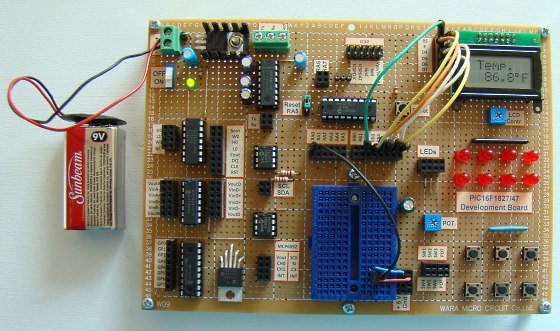
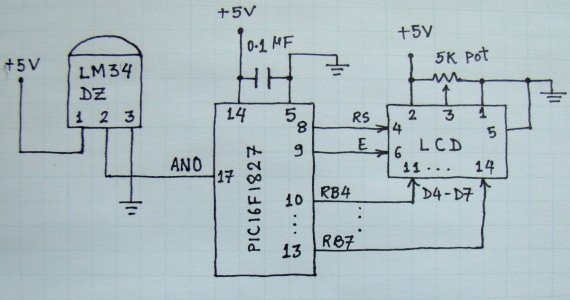
 It is called Fixed Voltage Reference (FVR) where the output is very stable and independent of the supply voltage (VDD). The output of the FVR can be configured to supply a reference voltage for A/D conversion internally. This article describes how to configure the FVR module to derive the reference voltage of 2.048 V for A/D conversion in PIC16F1827 microcontroller. The analog signal for this experiment is taken from the output of a LM34DZ temperature sensor. After the A/D conversion, the PIC16F1827 displays the temperature on a 2×8 character LCD.
Theory
LM34DZ temperature sensor
PIC16F1827 is a member of Microchip’s enhanced mid-range 8-bit microcontroller family. It is pin-compatible with the popular 18-pin predecessors such as PIC16F628A and PIC16F88, but is equipped with lot more peripherals and other features. The Fixed Voltage Reference (FVR) module in PIC16F1827 generates a stable voltage reference internally. The FVR output provides three software selectable voltage levels, 1.024V, 2.048V and 4.096V. The output can be configured to supply a reference voltage to the following:
 The actual generated reference voltage is 1.024 V, but with the help of programmable gain amplifiers, it can be amplified by 1x (1.024 V), 2x (2.048 V), or 4x (4.096 V), to produce the three possible voltage levels. The FVRCON register (shown below) is used to configure the settings for the fixed voltage reference. The bit values of FVRCON register to generate 2.048 V as the positive voltage reference for A/D conversion are shown in blue color font.
Once the FVRCON register is configured, the choice of reference voltage for A/D conversion is made through ADCON1 control register. By setting ADPREF<1:0> bits to ’1′, the positive reference voltage for A/D conversion is derived from the internal FVR module. Clearing the ADNREF bit connects the A/D negative reference voltage pin to the ground (VSS).
Current Project / Post can also be found using:
- pic16f77a led projects
The post Using Fixed Voltage Reference (FVR) for A/D conversion in enhanced mid-range PIC microcontrollers appeared first on PIC Microcontroller.